Capacitor Market Outlook: AI, Electric Vehicles, and Industrial Electronics Fuel Growth
The capacitor market is entering a fresh growth cycle, propelled by five converging technology waves: artificial intelligence, electric vehicles, industrial automation, renewable energy, and high-speed electronics. No longer seen as simple passive parts, capacitors have evolved into critical enablers of power stability, signal integrity, energy buffering, noise suppression, and long-term system reliability.
Several technological shifts are defining capacitor demand in 2026. AI server platforms depend on high-reliability MLCCs and polymer capacitors to ensure stable power delivery and precise voltage regulation. EVs and their charging infrastructure rely on film capacitors, aluminum electrolytic capacitors, and automotive-grade ceramic devices for DC-link smoothing, filtering, and energy conversion. Meanwhile, industrial systems, robotics, 5G base stations, smart meters, medical equipment, and other embedded applications continue to draw heavily on a steady supply of capacitors for both power and signal functions.
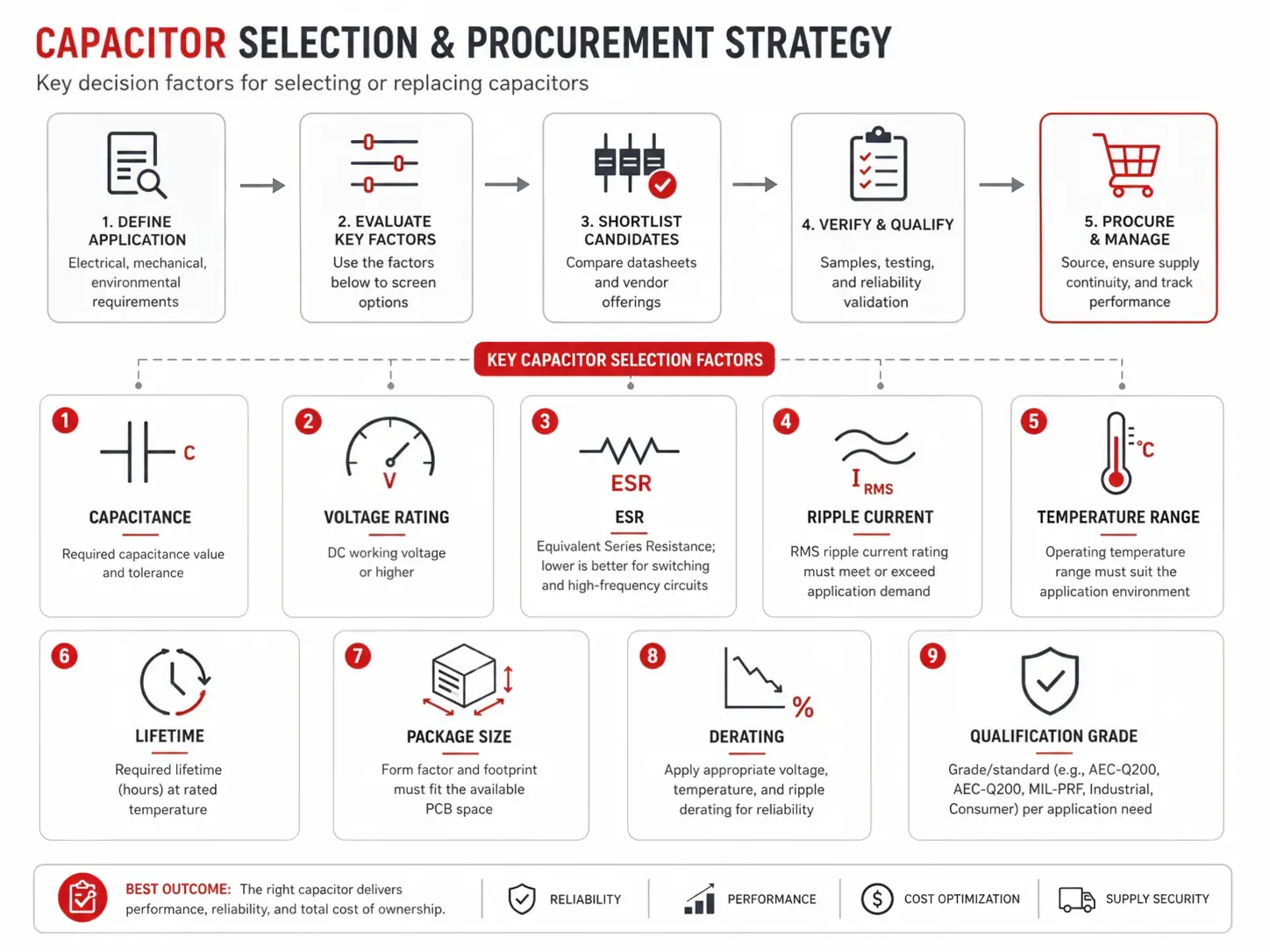
For design engineers and procurement teams alike, choosing a capacitor today goes well beyond matching capacitance and voltage ratings. Key considerations now include dielectric material, ESR, ripple current capability, operating temperature range, package dimensions, service life, derating requirements, qualification standards, product lifecycle status, and supplier continuity. As application requirements grow more specialized, strategic sourcing and proactive replacement planning have become essential parts of the capacitor supply chain.
1. Why Capacitors Matter More Than Ever in Modern Electronic Systems
Capacitors have always been present in electronic systems, but today's designs demand far more of them—both in quantity and in performance. From AI accelerators and high-current processors to advanced power modules, high-speed interfaces, battery management systems, and automotive control units, virtually every critical subsystem relies on stable voltage rails and clean, dependable power delivery.
In AI servers, capacitors absorb the rapid load transients generated by GPUs, CPUs, memory modules, and power converters. In electric vehicles, they underpin inverter systems, onboard chargers, DC/DC converters, battery management circuits, and infotainment electronics. In industrial control applications, they stabilize power supplies, filter out noise, safeguard control boards, and ensure reliable operation under harsh temperature and vibration conditions.
As electronic systems grow faster, smaller, and more power-dense, the performance of capacitors directly determines overall product stability. A single poorly chosen capacitor can lead to power ripple, EMI problems, overheating, premature aging, or even field failures. For this reason, capacitor selection has become a critical concern for both engineering and procurement teams.
2. MLCC Demand Surges on the Back of AI Servers and Automotive Electronics
Among all capacitor technologies, multilayer ceramic capacitors (MLCCs) continue to hold a dominant position in the electronics industry. Prized for their small footprint, stability, and suitability for high-density PCB layouts, they are seeing particularly strong demand in 2026 for high-capacitance, high-voltage, automotive-grade, and high-reliability variants—driven largely by the rapid growth of AI servers and electric vehicles.
A single AI server board may require hundreds of ceramic capacitors for decoupling, filtering, and power rail stabilization. Automotive electronics likewise rely on qualified MLCCs across ADAS systems, infotainment, battery management, motor control, body electronics, and communication modules. Compared with consumer applications, these use cases demand greater reliability, broader operating temperature ranges, and stricter qualification standards.
The central challenge for buyers is that MLCCs are far from interchangeable. A standard consumer-grade part can easily fall short in automotive or high-reliability industrial environments. Before approving any replacement, engineers should carefully evaluate capacitance stability, voltage derating behavior, dielectric class, DC bias characteristics, temperature rating, package size, and qualification level.
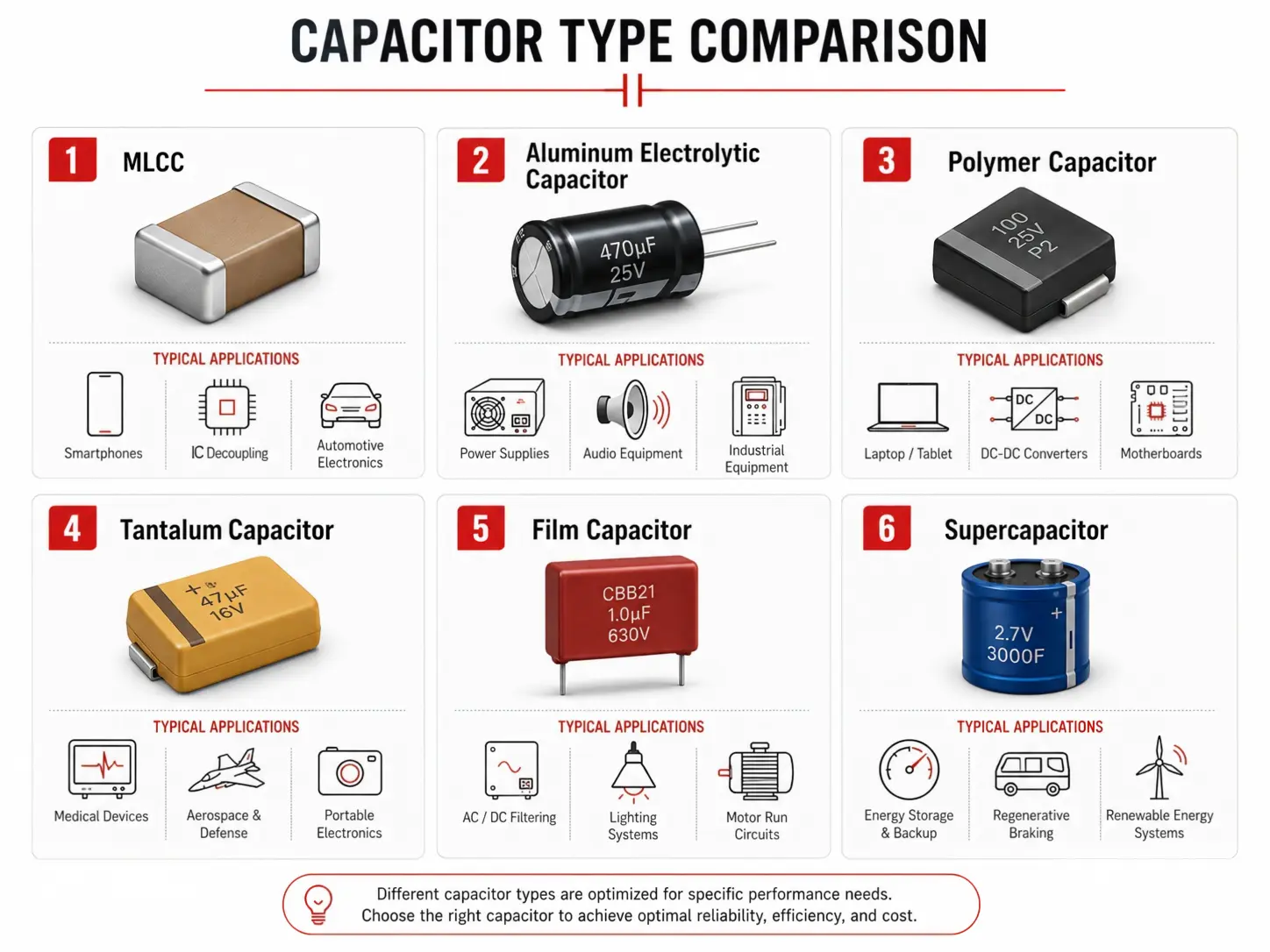
3. Aluminum Electrolytic, Polymer, Film, and Tantalum Capacitors Continue to Play a Vital Role
Although MLCCs often dominate the spotlight, other capacitor technologies are equally indispensable in power electronics and industrial systems. Aluminum electrolytic capacitors, for instance, are workhorses in power supplies, adapters, industrial drives, audio equipment, inverters, and household appliances. Their high capacitance and low cost are attractive, but engineers must carefully weigh lifetime, ripple current capability, ESR, and temperature ratings when using them.
Polymer capacitors, with their lower ESR and superior high-frequency performance compared to conventional electrolytics, have become a natural fit for high-current power rails, computing platforms, networking equipment, and compact power modules. Tantalum capacitors, meanwhile, are prized for their capacitance stability, small footprint, and reliability in selected applications—though buyers need to remain mindful of voltage derating requirements and supply chain risks.
Film capacitors deserve particular mention. They play a key role in power conversion, renewable energy systems, EV charging infrastructure, motor drives, and DC-link circuits, delivering excellent stability, high voltage capability, and dependable performance under severe electrical stress. As power electronics continues to expand, film capacitors will remain a strategic component category for industrial and energy applications.
4. Comparing Capacitor Types at a Glance
| Capacitor Type | Core Advantage | Common Use Cases | Key Factors for Buyers |
|---|---|---|---|
| MLCC | Compact footprint, high reliability, excellent high-frequency response | AI servers, smartphones, automotive electronics, industrial control, RF circuits | Verify dielectric class, DC bias effect, temperature range, voltage derating, and qualification grade |
| Aluminum Electrolytic Capacitor | Large capacitance in a single package, economical bulk energy storage | Power supplies, motor drives, adapters, industrial equipment, audio systems | Assess service life, ripple current handling, ESR, leakage current, and operating temperature |
| Polymer Capacitor | Very low ESR, outstanding ripple performance, ideal for compact power rails | Computing, networking, GPU boards, DC/DC converters, high-current rails | Confirm ripple current rating, voltage margin, board footprint, and endurance |
| Tantalum Capacitor | Stable capacitance, small size, proven reliability in critical circuits | Industrial electronics, telecom, aerospace, medical devices, compact power circuits | Observe voltage derating rules and verify supply availability |
| Film Capacitor | High voltage capability, low losses, exceptional reliability | EV inverters, renewable energy, DC-link, motor drives, power conversion | Consider voltage rating, capacitance tolerance, thermal performance, and physical dimensions |
| Supercapacitor | High power density with rapid charge/discharge cycles | Backup power, energy harvesting, smart meters, industrial memory retention | Review voltage balancing, leakage current, cycle life, and temperature range |
5. AI Servers Are Putting New Strains on Passive Components
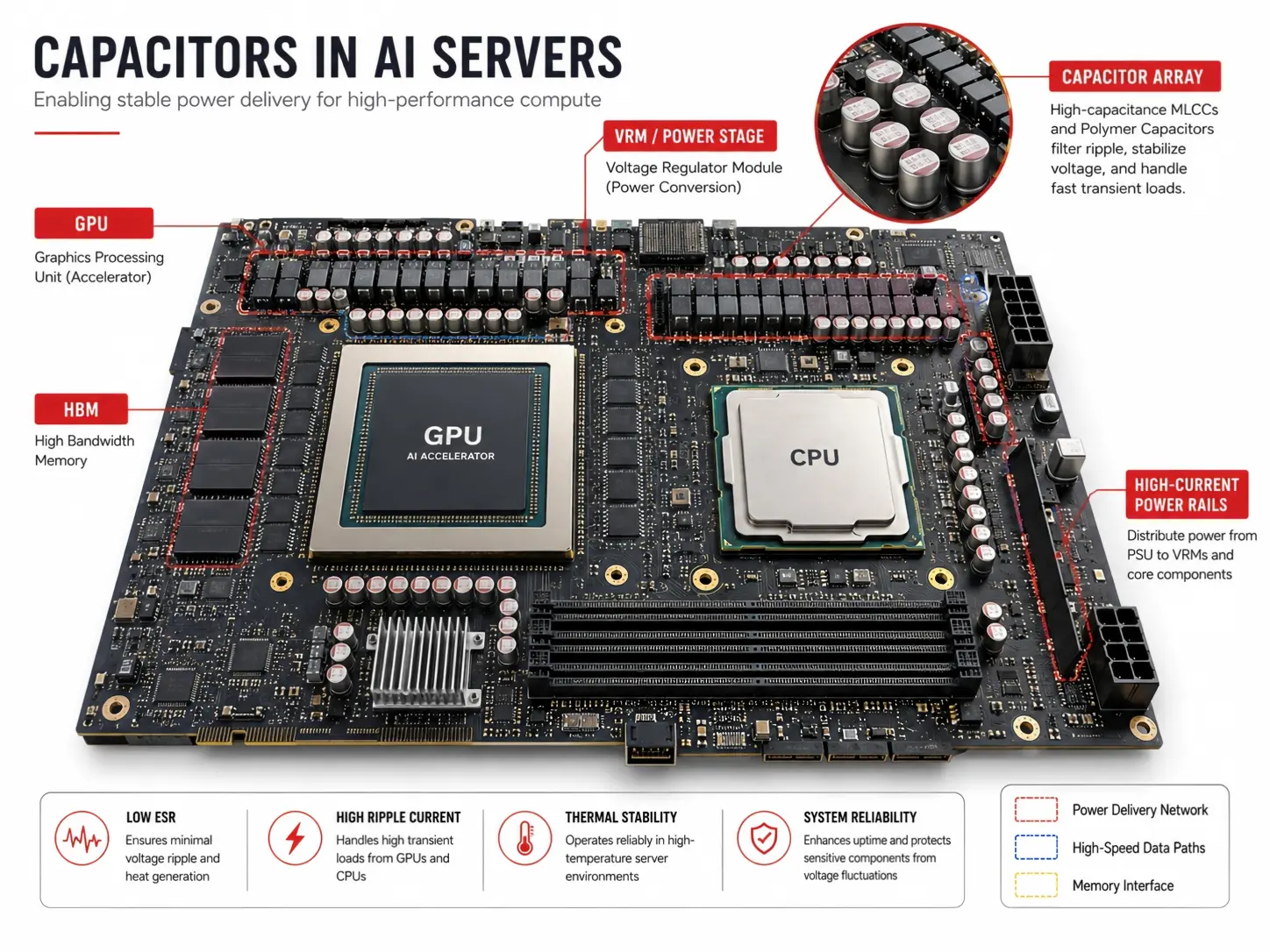
AI servers demand exceptionally dense power delivery networks. With GPUs, CPUs, HBM memory, high-speed networking chips, PCIe switches, and storage controllers all drawing rapidly fluctuating currents, capacitors are deployed throughout the system to maintain voltage stability, filter noise, suppress ripple, and keep operations reliable.
This, in turn, is driving up demand for high-capacitance MLCCs, low-ESR polymer capacitors, tantalum capacitors, and other high-reliability passives. The catch for buyers is that AI server designs often call for capacitor performance windows that standard commodity parts simply cannot meet.
Procurement teams would be wise to monitor lead times closely for high-capacitance ceramic capacitors, automotive-grade MLCCs, polymer capacitors, and high-reliability tantalum devices. Even when the overall capacitor market appears well supplied, certain high-performance segments can quickly turn tight.
6. EVs and Renewable Energy Are Fueling Demand for Power Capacitors
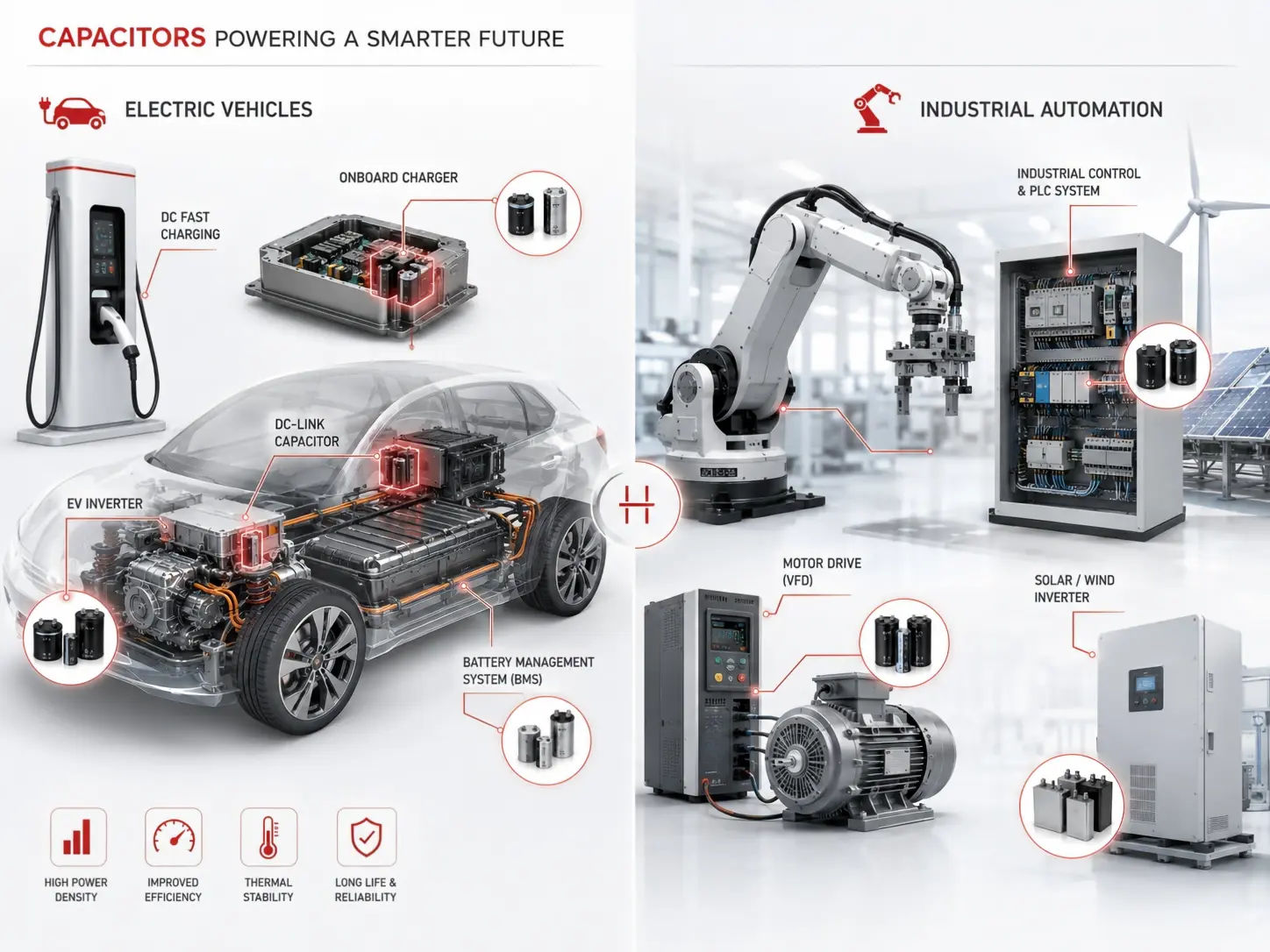
Power capacitors are essential components across electric vehicles, charging infrastructure, solar inverters, energy storage systems, and motor drives. Among them, film capacitors are the go-to choice for DC-link applications, thanks to their ability to handle high voltages, low losses, and dependable performance under the stress of power conversion. Aluminum electrolytic and hybrid capacitors also play a key role in power supplies, control boards, and auxiliary circuits.
Inside vehicles, capacitors show up in battery management systems, onboard chargers, DC/DC converters, infotainment units, lighting modules, sensors, and ADAS electronics. As vehicles become increasingly electrified and software-driven, the amount of capacitor content per vehicle keeps rising.
For automotive applications, buyers should focus on certified parts, dependable suppliers, long-term supply continuity, and well-defined derating guidelines. A capacitor operating in an automotive environment often demands better thermal performance and reliability than one with the same rating used in consumer products.
7. Procurement Strategy: How Buyers Can Reduce Capacitor Supply Risk
Capacitor sourcing is becoming more strategic, because availability varies widely by voltage, capacitance, package, dielectric, and manufacturer. Buyers should not assume capacitors are interchangeable.
- What to check:
- Electrical specs: capacitance, voltage, ESR, ripple current, leakage current, tolerance
- Proper voltage and temperature derating
- Package size and its impact on layout and heat dissipation
- Required qualifications (automotive, industrial, medical, etc.)
- Second sources and alternative parts, prepared in advance
- Avoid obsolete or end-of-life series
A good strategy = engineering validation + purchasing flexibility. A replacement is not just the closest capacitance value — it must match the circuit function, operating environment, reliability target, and production needs.
8. HANYUCHIP's Product Portfolio and Content Strategy Opportunities
The capacitor market is a great opportunity for distributors. Buyers often need help choosing parts, finding replacements, and understanding requirements. For hanyuchip.com, capacitor content can support engineers and buyers in AI servers, automotive, industrial, power supplies, renewable energy, and embedded systems.
- Topics to cover:
- MLCC comparisons
- Aluminum electrolytic selection
- Polymer capacitor replacements
- Tantalum derating
- Film capacitor uses
- Supercapacitor backup power
- Automotive capacitor selection
- Power supply capacitor sourcing
MLCC Selection Guides
Create content covering ceramic dielectric types, voltage derating, DC bias effects, package size selection, and high-reliability applications.
Power Capacitors in Action
Create guides covering electrolytic, polymer, film, and DC-link capacitors used in power and industrial applications.
Capacitor Cross-Reference Guides
Create replacement pages covering common values, voltage ratings, package sizes, and part series.
Capacitors for Automotive & Industrial Use
Write content covering automotive-grade MLCCs, industrial electrolytic capacitors, film capacitors, and long-life designs.
9. Conclusion: Capacitors Are Now a Strategic Consideration
Capacitors are still basic components, but they matter more than ever. AI servers, electric vehicles, renewable energy, industrial automation, and high-speed electronics all demand better power stability and higher reliability. MLCCs, aluminum electrolytics, polymers, tantalums, film capacitors, and supercapacitors each play a distinct role in modern systems.
For engineers: selection means carefully evaluating electrical performance, environmental stress, derating, lifetime, and qualification requirements.
For buyers: sourcing means tracking lead times, securing second sources, and knowing which categories may face supply constraints.
As electronics become more power-dense and reliability-driven, capacitors will stay a key product category across industrial, automotive, AI infrastructure, renewable energy, and embedded applications.
Sourcing Capacitors and Passive Components at Hanyuchip
Need capacitors or passive components for AI servers, automotive, industrial, power, renewable energy, or embedded applications? Visit www.hanyuchip.com to browse available models, compare options, and send your inquiry. www.htelec.com to search available models, compare alternatives, and submit your purchasing inquiry.
Visit HTELECRecommended Reading
Related information
-
PSX3XLUB1250X Littelfuse Inc.
-
XC6124C342ER-G Torex Semiconductor Ltd
-
XC6127N46JMR-G Torex Semiconductor Ltd
-
XC6122A348ER-G Torex Semiconductor Ltd
-
XC6123C742ER-G Torex Semiconductor Ltd
-
MAX4062EUB+ Analog Devices Inc./Maxim Integrated
-
ADJD-E622-QR999 Broadcom Limited
-
EDMCONNECTORKIT Wandboard.Org
-
SC1163 Raspberry Pi


